_________________________________
Today's Daily Dose of Hope is sponsored by Superhuman AI, the daily newsletter that helps you learn AI in about three minutes a day. Like the DDH, it's a small daily habit, and it keeps you curious and a little more ready for what's coming. If you want to see how these tools can make your work easier, look below.Put on a pair of glasses after a long stretch without them and watch what your face does. The squint lets go. Your head tilts back a little. Something that was a smear a second ago turns into a leaf, a street sign, or someone’s eyes.
_________________________________
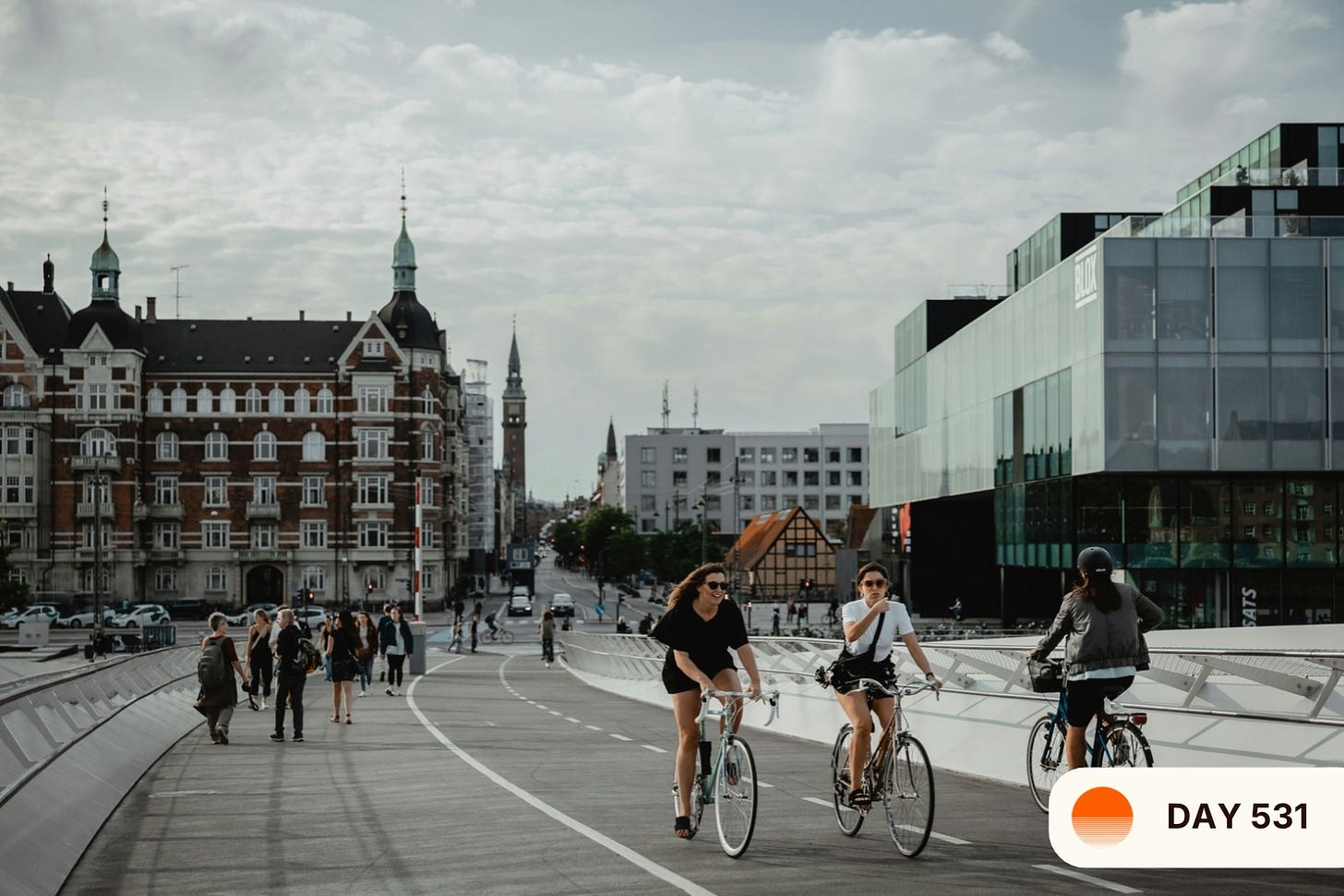
When I was riding my bicycle the normal 15 miles (approximately 24 kilometers) I travel through forests, wetlands, industrial areas and along a river, I wondered how far hope can travel on two wheels. So, I went looking. The answer turned out to be a lot farther than you’d guess. And in very different directions.
Here’s what I found in five countries where members of our hopeful community live.
India: a girl, a bicycle, and a school that suddenly isn’t too far
In 2006, the Indian state of Bihar started giving a bicycle to girls who stayed in secondary school. Two economists later studied what happened. Girls’ age-appropriate enrollment in secondary school rose 32 percent. And the gender gap shrank by 40 percent. The gains came mostly in villages where the nearest school was far away. The researchers pointed to the time and safety cost of the trip as the thing the bicycle removed. They also noted that girls riding in groups felt safer. It also chipped away at old norms about women moving outside the village1.
A bicycle did what a lecture on opportunity never could. It made the road to school short enough to believe in.
Kenya: the long walk gets shorter
At a secondary school in Kakamega County, students who used to walk five to eight kilometers each way now save hours a day. The head teacher told World Bicycle Relief that the bikes lifted self-esteem, especially for the girls. The boys are expected to offer rides to any girl they see walking the same way. That’s a safe alternative to the motorbike taxis2.
One mother in Siaya County uses her daughter’s bike to haul water. Compared to walking, a bicycle is four times faster and carries five times as much water per trip. The organization’s own figures claim attendance gains of up to 28 percent. That’s their number, not an independent one, but the stories line up with it3.
Uganda: the ambulance with pedals
About 15 women a day die in Uganda from pregnancy and childbirth complications. Seventy-seven of its 121 districts have no ambulance service. So a group called FABIO built bicycle ambulances, starting in the war-torn north in 2006. A local rider carries a pregnant woman or a sick child to the clinic on a trailer, in places a car can’t reach. Some of the riders are village health volunteers4.
Hope doesn’t get much more literal than that. Somebody shows up and the clinic is suddenly reachable.
The Netherlands: grief turned into bike lanes
In 1971, Dutch roads killed 3,300 people, including more than 400 children. Journalist Vic Langenhoff, whose six-year-old daughter had been killed by a car, helped start a campaign called Stop de Kindermoord. Parents blocked traffic, lay down on the road, painted bicycle symbols where they wanted bike lanes and held up banners. The country slowly rebuilt its streets around people instead of cars5.
That’s a hard story and I don’t want to soften it. But it’s one of the clearest examples I know of grief becoming infrastructure. The hope in Dutch cycling wasn’t there at the start. People built it.
The United Kingdom: hope for the commuter’s mind
Researchers at the University of Edinburgh looked at almost 380,000 people. Commuting by bike was linked to a lower risk of mental ill-health. In one dataset, 9 percent of cycle commuters had a mental health prescription, compared with 14 percent of non-cyclists. The authors argue the link is causal, not just a correlation. A separate study across seven European cities, including London, found that cycling was tied to better mental health and fewer feelings of loneliness6.
So that’s the British version of the answer. Hope can be as quiet as a Tuesday morning that goes a little better because you rode in.
So how does a bicycle give hope?
Honestly, I count four ways, and each country showed me one of them:
* It shortens distance (India, Kenya).
* It gets help to people who’d otherwise wait (Uganda).
* It lets a community turn loss into something lasting (the Netherlands).
* It steadies the mind of the person pedaling (the UK).
A bicycle isn’t a cure for poverty, bad roads or a hard commute. It does give you the feeling that your own effort moves you somewhere. I think that’s why it keeps turning up in hopeful stories.
Hope isn’t always a big idea. Sometimes it’s a girl, a seat and eight fewer kilometers of walking.
Hope often starts as a matter of distance. Whatever feels too far away today, the school or the clinic or the better version of your week, may need only a smaller gap and a way to cross it. What’s one thing that feels out of reach for you right now? Is there a small way to make the trip shorter?
Question
When did you last ride a bike, or watch someone else ride one, and feel your mood lift for no reason you could name? Tell me where you were. I’d love to read your stories, wherever in the world you’re reading from.
Attributions
1 Cycling to School: Increasing Secondary School Enrollment for Girls in India
2 Beasts of burden: The bicycle vs. the donkey
3 The community impact of 100 bicycles
4 Uganda’s bicycle ambulances help the pregnant, sick and injured
5 How did a Dutch prime minister’s 1973 decision to ban cars every Sunday accidentally turn a whole country into the world’s cycling capital within a decade?
6 Cycling to Work Could Prevent Anxiety, Depression
Daily Dose of Hope Mug
$24.00
Start your day with a sip of Hope. Every mug supports Bernard’s mission to find and share the stories that prove hope is alive and well. Keep one for yourself, or give it to someone who needs the reminder.
Buy now
A Daily Dose of Hope — one short reflection each day about where hope lives in our world. Read in 50 states in the US and 160 countries of the 195 countries throughout the World.
Members of our community in 82% of the countries in the World!