_______________________________
Thank you, Scalis, for supporting this newsletter and the readers who open it each day.
Scalis is an AI-native applicant tracking system and job board that runs hiring from first post to signed offer. Candidates who miss out on one role can opt in to be considered for others. Their tagline is “Hiring Shouldn’t Suck™,” and I couldn’t agree more.
_______________________________
This Daily Dose of Hope is a republishing of a post I wrote on Substack on June 1, 2026. So many of you are writing to me about your faith that it seemed like the right time to bring this post back. I hope you enjoy it.
What do you believe in the moment between dying and coming back?
Eight years ago, I flatlined.
My heart stopped. The monitors went silent. And somewhere in that space — that impossible, unmeasurable space between here and gone — something happened that I am still, to this day, trying to find the right words for. I came back. And the first coherent thought I had wasn’t fear, or relief, or even gratitude. It was quieter than all of that. It was this:
Almost one year of the Daily Dose of Hope. If it’s added something to yours, consider becoming a paid subscriber. If you are still thinking about its value, please subscribe for free.
There’s a reason.
I didn’t know what the reason was. I still don’t know the full shape of it. But I have never — not for a single day in the eight years since — stopped believing it exists. And I’ve come to understand that that belief, that stubborn, unverifiable, unshakeable certainty that my surviving meant something, is the purest definition of faith I have ever encountered.
Which makes me want to ask you: what does faith mean to you?
I’ve been sitting with this question ever since a member of our community sent me a message that stopped me mid-scroll. She wrote: “I don’t go to church. I don’t pray. But every morning I wake up believing today will be different. Is that faith?”
It is. And with 63 countries now in this community — sixty-three — when I write the word faith, it lands differently in each of you. For some, it is God. For others, it is science. For some, it’s the stubborn, irrational belief that the phone will ring with good news. For others, it’s a grandmother’s voice saying you’re going to be okay, baby. All of it counts.
So let’s talk about what faith actually is — because I think most of us have been handed a definition too small for what we actually experience.
Faith, through a religious lens…
is trust in something larger than yourself — a divine presence, a sacred text, a spiritual lineage that stretches back further than your own life. For billions of people, faith is relational. It is a conversation with God, Allah, the Universe, the ancestors. It is the practice of surrender: I don’t fully understand, but I trust the design. This kind of faith doesn’t require certainty. In fact, most theologians across traditions will tell you faith lives precisely in the absence of certainty. Doubt isn’t the opposite of faith. Doubt is often where faith begins.
I know this firsthand. Lying in a hospital bed after my heart attack, I wasn’t certain of anything — not theologically, not medically, not personally. But I was certain of one thing: I was still here, and that meant something. That certainty had no proof behind it. It was pure faith.
Secular faith…
is quieter, but no less real. It’s the scientist who doesn’t know if the experiment will work but runs it anyway. It’s the mother who keeps showing up for a child who has pushed her away. It’s the entrepreneur who pitches again after the third rejection. The philosopher William James called this the “will to believe” — the active choice to act as if something is possible before you have proof. That choice, James argued, is itself a creative force. It changes what becomes possible. When I started building this community in the years after my heart stopped, I had no proof it would matter. I had a will to believe it might. That’s secular faith. That’s also how this community reached 63 countries.
Relational faith…
and this one I think we under-celebrate — is faith in people. The belief that humans, despite all evidence to the contrary, are fundamentally trying. I saw it in the faces of the medical team working on me. People who had never met me, pouring themselves into keeping me here. Relational faith is what holds communities together. It’s what makes you trust a new friend, love a new city, believe in a new beginning. It’s what makes a stranger’s hands feel like the hands of someone who was always supposed to find you.
Embodied faith…
perhaps the most overlooked — lives in the body, not the mind. My body kept fighting before my mind had any say in it. My heart, when it came back, didn’t ask for my permission. It just resumed. There is something in us — call it biology, call it spirit, call it grace — that orients toward survival before we’ve consciously chosen it. This is faith as muscle memory. As instinct. As the part of you that keeps breathing even when your mind has given up the argument. I didn’t think my way back. Something deeper than thought made the decision.
Surprising Research
Here’s the surprising thing research keeps confirming, and it still startles me: people with a strong sense of faith — religious or secular — recover from trauma measurably faster. A landmark study published in the Journal of Health Psychology found that what predicted resilience wasn’t the specific content of someone’s belief system. It was the coherence of it. The sense that life has meaning, that suffering isn’t random, that there is a story you’re inside of — that orientation, whatever its source, appears to be neurologically protective. Faith isn’t just comfort. It is a cognitive architecture that makes hope structurally possible.
I lived this. The belief that I survived for a reason didn’t just make me feel better. It made me move differently. It gave the days after my heart attack a direction. I didn’t need to know the reason’s full shape to let it guide me. The faith in its existence was enough.
Which brings me to the relationship between faith and hope — because they are not the same thing, even though they live in the same house.
Hope is the destination. Faith is the road.
Hope is “things will get better.” Faith is the belief that getting there is possible — even when you can’t see the path, even when the monitors have gone flat, even when the room has gone very, very quiet. Faith is what you carry when hope goes silent. When I flatlined, I wasn’t capable of hope — I was unconscious. But something in me, or around me, or both, had faith on my behalf. And I came back into a world that still had reasons in it.
Here’s the stance I want to take today, one that might surprise you:
I don’t think surviving is random, and I don’t think you need a medical explanation to know that. Every person who has walked through something they shouldn’t have survived — a diagnosis, a crash, a night that felt unsurvivable — and come out the other side carrying the question why am I still here? is already living inside faith. The question itself is an act of faith. You’re asking it because you believe the answer exists.
I believe it does. For you. For all of us still here, still asking.
Faith isn’t the absence of fear. It’s what walks beside you when fear shows up anyway. Sometimes it’s what carries you when you can no longer walk at all.
Soft, aching, and full of the kind of hope that doesn’t shout — it whispers. The lyric “I saw a friend of mine the other day / and he told me that my eyes were gleaming” captures something faith does that we rarely talk about: it shows in you before you even realize it’s there. It’s what people saw in me after my heart attack, long before I felt it myself. Play this on a morning when you need to remember you still have it — because you do.
Before you go — one specific question
If you’ve ever walked through something you weren’t sure you’d survive — an illness, a loss, a moment where the ground disappeared — what did you hold onto? Not what should you have held onto. What did you actually reach for in that moment?
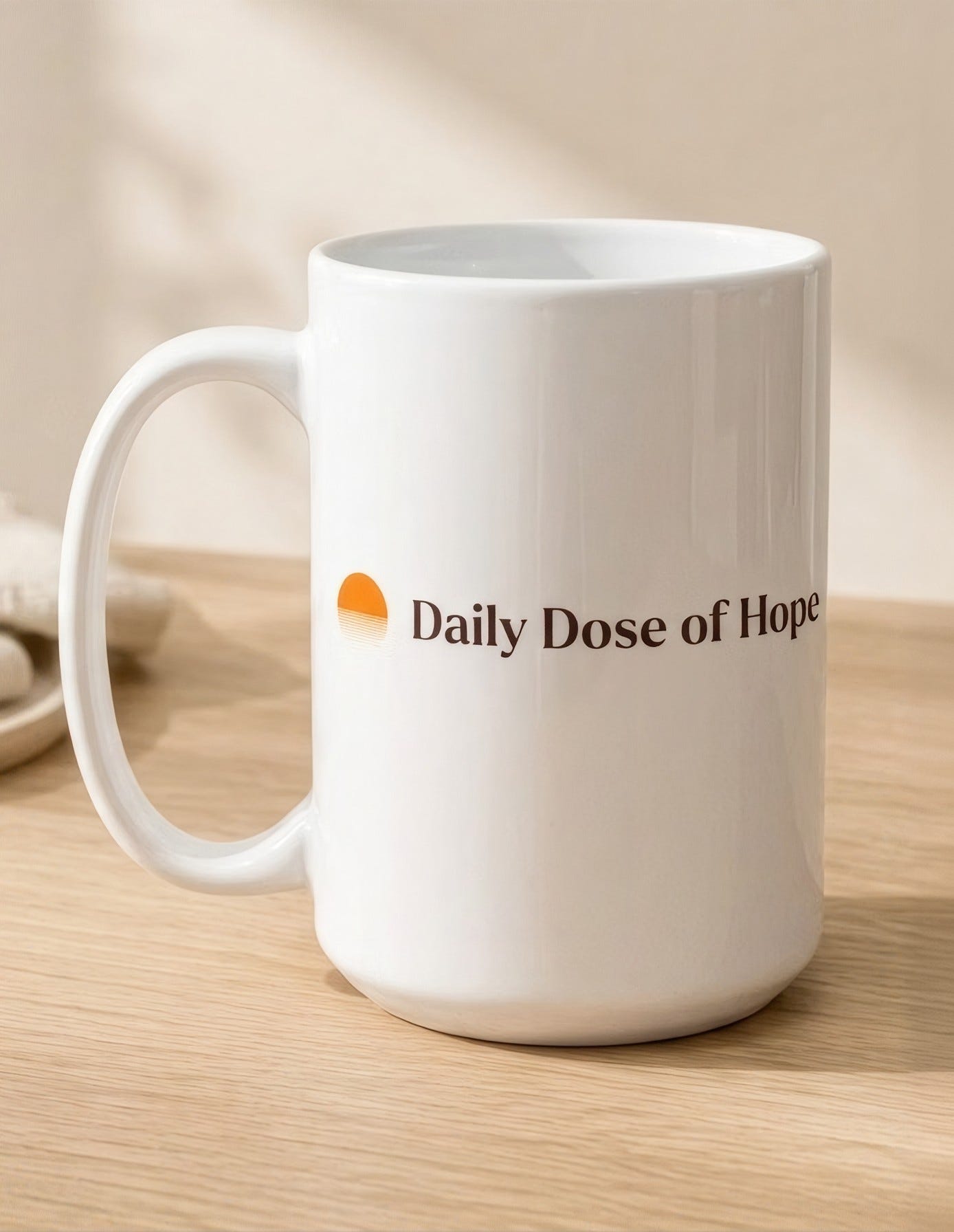
Daily Dose of Hope Mug
$24.00
Start your day with a sip of Hope. Every mug supports Bernard’s mission to find and share the stories that prove hope is alive and well. Keep one for yourself, or give it to someone who needs the reminder.
Buy now
A Daily Dose of Hope — one short reflection each day about where hope lives in our world. Read in 50 states in the US and 160 countries of the 195 countries throughout the World.
Members of our community in 82% of the countries in the World!