_____________________________
Thank you to Kit for sponsoring today’s Daily Dose of Hope; your support helps me keep showing up for readers every day. Kit (formerly ConvertKit) is an email marketing and newsletter platform built for creators, with tools for landing pages, forms, automated email sequences, and selling digital products or paid newsletters. It’s trusted by more than 550,000 creator business owners, and you can learn more at kit.com.
_____________________________
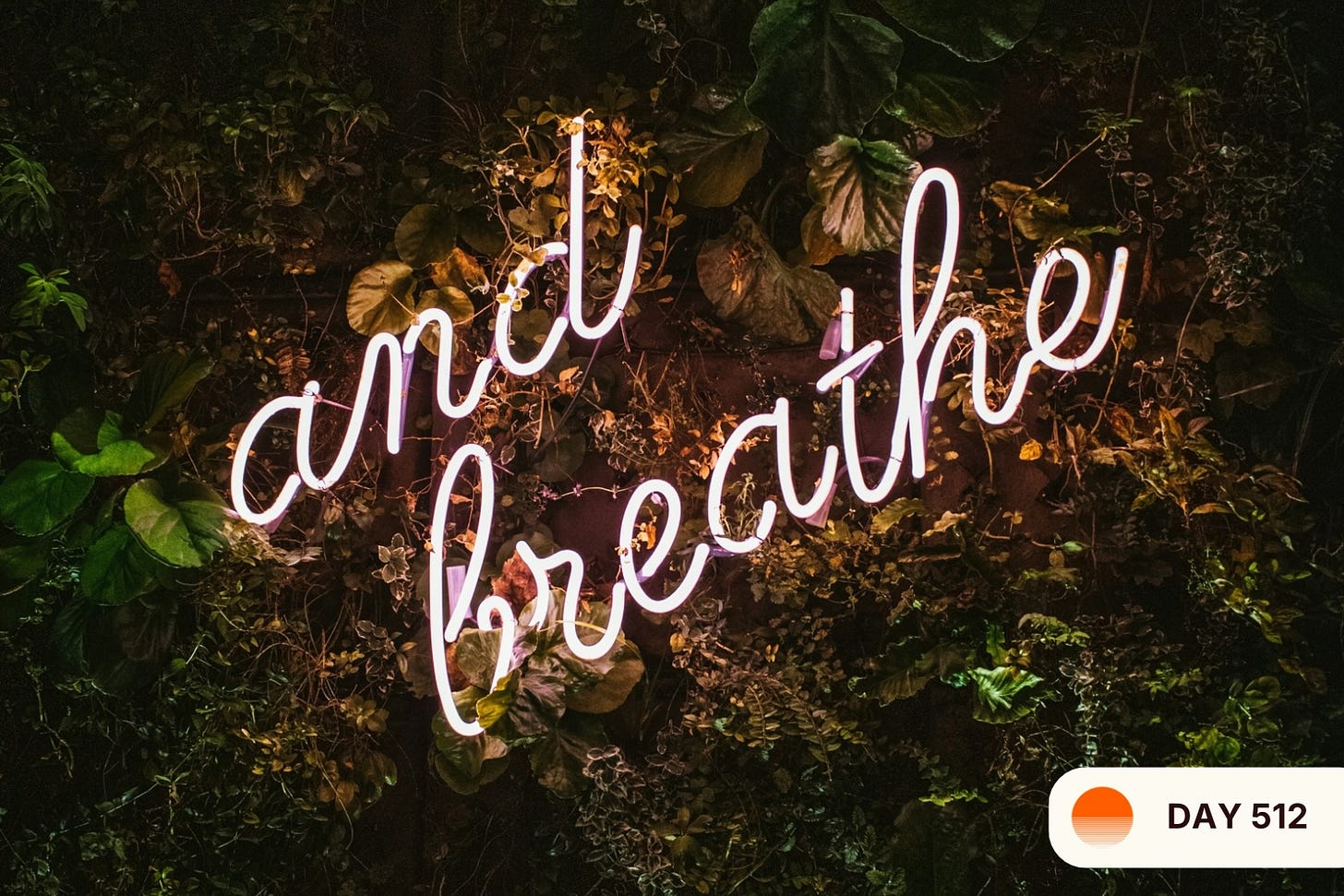
Since you started reading this post, you have already taken about a dozen breaths. And you didn’t plan a single one of them.
As long as the body functions properly, breathing runs on its own. Yet, unbeknownst to many of us, it is the one body function that we can grab and steer whenever we want to do so.
Today I wanted to know whether steering it can move something bigger than just your lungs. Can it move hope?
First, what are we talking about?
Breathing is the plain mechanical act. The Britannica Dictionary defines it as “moving air into and out of your lungs, inhaling and exhaling.”
The breath is the bigger word. Dictionary.com lists it as “the air we inhale and exhale, but also as life and vitality, and as a pause or respite.” I think it is great that one dictionary entry holds all three. Every language seems to know that a breath is much more than just air. It’s a sign you’re still here.
Yoga: the breath as a practice
Pranayama is the breathing side of yoga. A 2025 review pooled six randomized trials with 517 patients dealing with PTSD, depression, and other mental health conditions. It found short-term benefits when breathing practices were added to outpatient and inpatient care.
A smaller Brazilian trial had healthy young adults practice a pranayama technique for four weeks. Their anxiety and negative mood dropped. And, their brain scans showed changes in regions that handle emotion. Yoga more broadly shows a modest signal as well. A meta-analysis found small short-term reductions in anxiety compared with no treatment.
Meditation: the breath as an anchor
Meditation speaks directly to hope. Researchers at Canterbury Christ Church University randomly assigned 474 adults to either a 10-minute mindfulness-of-the-breath session or a 10-minute audiobook. The meditators showed a significant gain in state hope (d = 0.68) and an even larger gain in gratitude. Ten minutes, done online. It is remarkable how clearly this showed up.
An earlier, smaller study (46 people) suggests why. Meditation raised hope. And, the analysis pointed to reduced stress as the link between the two. Calm the alarm and hope has room to come back in.
Slow breathing: the breath as a dial
You don’t need a mat or a teacher for this one. A large review pulled together 223 studies on voluntary slow breathing. It found that heart rate variability, a marker of the calming parasympathetic system, went up during slow breathing, right after a session, and after weeks of practice.
Here’s another example from the lab. In one experiment, students who did just two minutes of breathing with a longer exhale than inhale didn’t show the stress rise the waiting group did. And, they answered more business-case questions correctly. Two minutes. Longer out-breath than in-breath. That’s the whole recipe.
The honest answer
Breathing won’t cure depression and no one in these studies claims it will. The effects are short-term and moderate and they vary from person to person. Still, the pattern across all three methods is the same. When you slow your breath, your body stops sounding the alarm, and a calmer body makes it easier to picture a next step. Hope tends to show up there.
I can’t tell you it works for everyone. I can tell you it costs nothing and you can test it before you finish this sentence.
Hope doesn’t always arrive as a big idea. Sometimes it arrives as a long exhale.
Your breath is the one part of you that’s always in the present moment and always open to a fresh start. Each exhale is a small letting go, and each inhale is a small yes.
Question
When did a single deep breath last change how a hard moment felt for you? And what were you facing when it did?
ATTRIBUTIONS
- Britannica Dictionary: breathe
- Dictionary.com: breath
- Mütze et al., Effectiveness of pranayama for mental disorders, Frontiers in Psychiatry, 2025
- Novaes et al., Bhastrika pranayama RCT, Frontiers in Psychiatry, 2020
- Cramer et al., Yoga for anxiety, Depression and Anxiety, 2018
- Strohmaier, Jones & Cane, One-session mindfulness of the breath, Mindfulness, 2022
- The Effects of Mindfulness Meditation on Hope and Stress, Research on Social Work Practice, 2015
- Laborde et al., Voluntary slow breathing and HRV meta-analysis, 2022
- De Couck et al., Breathing patterns and decision-making, 2019
A Daily Dose of Hope — one short reflection each day about where hope lives in our world. Read in 50 states in the US and 157 countries of the 195 countries throughout the World.
Members of our community in 80% of the countries in the World!