_________________________________
Today's Daily Dose of Hope is sponsored by Superhuman AI, the daily newsletter that helps you learn AI in about three minutes a day. Like the DDH, it's a small daily habit, and it keeps you curious and a little more ready for what's coming. If you want to see how these tools can make your work easier, look below.Put on a pair of glasses after a long stretch without them and watch what your face does. The squint lets go. Your head tilts back a little. Something that was a smear a second ago turns into a leaf, a street sign, or someone’s eyes.
_________________________________
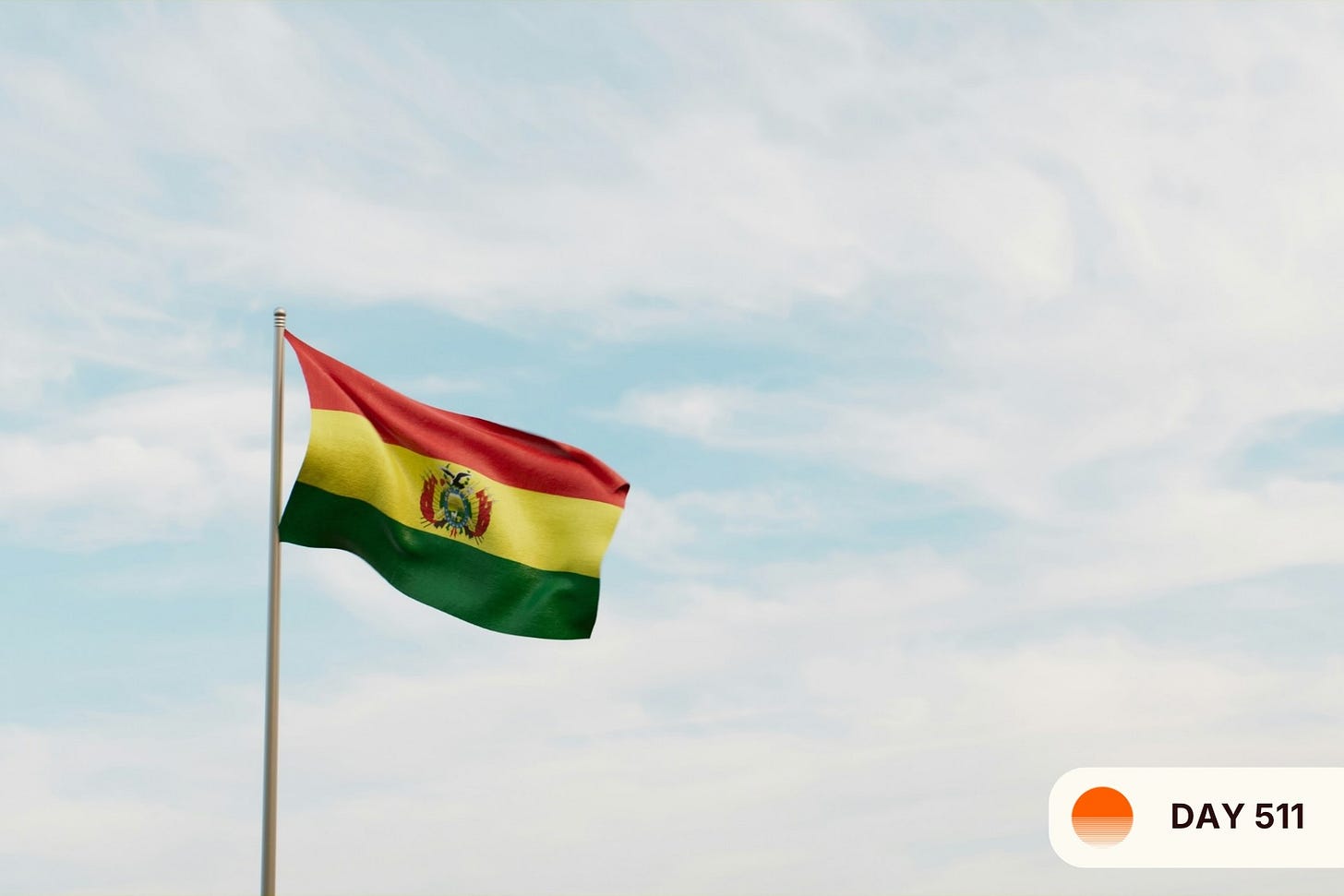
Our Daily Dose of Hope community has grown again. It now includes Bolivia. To our community members in Bolivia, welcome! We are glad you are here. Your presence gives us an opportunity to both learn about another country and to recognize the people helping shape its future.
In researching your country, three kinds of hope stand out to me: cultural hope that keeps identity alive, ecological hope that turns care into action, and practical hope that improves everyday life. These aren’t just claims that everything is well; they are reasons to believe that meaningful work does matter.
Cultural hope: A future that does not require forgetting
One compelling expression of Bolivia’s cultural hope is the work of singer Luzmila Carpio. Last month, she received the WOMEX Artist Award. It recognizes six decades of her artistry, contribution to preserving and sharing the Quechua language and Indigenous musical traditions as well as her commitment to women’s rights and environmental protection. Her music connects traditional Quechua singing with contemporary sounds, bringing inherited knowledge to new audiences1.[lostiempos]
This award and Luzmila’s artistry demonstrates the hope of belonging. It shows that the possibility of moving forward does not require leaving one’s language, ancestors, or identity behind. A living tradition is not simply something stored safely in the past. It is something people continue to sing, interpret, and share.
That hope isn’t a guarantee. Research I did on Bolivia’s languages warns that many are critically endangered. The work of passing them on is therefore both a celebration and an urgent responsibility2.[resolve.cambridge]
Ecological hope: Caring for land by strengthening its communities
In Bolivia’s Chiquitanía region, a project supported by Manos Unidas is working with ten Indigenous and farming communities to strengthen food security, protect forests, and increase women’s and young people’s participation in territorial decision-making. Its priorities and activities include agroforestry (growing trees and crops together) along with closer cooperation with municipal governments on sustainable forest management and environmental risk prevention. These are project objectives and activities, not proof that the region’s challenges have been solved3.[elfaradio]
My hopeful reading as well as personal insight is that environmental care becomes much more durable when people have a meaningful voice in it. Forest protection, family livelihoods, and community leadership need not be treated as separate concerns. They can reinforce one another.
Laguna Chica is a concrete example. The Global Forest Coalition has documented Guaraní women’s struggle to recover communal territory and their efforts to reforest land cleared by previous landholders. Their story connects the recovery of rights with the responsibility of restoration4.[globalforestcoalition]
This is hopewith its hands in the soil: not pretending that damage never happened, but deciding that damage will not have the final word.
Practical hope: Light, water, and greater possibility
Bolivia has seen persuasive hope arrive through ordinary necessities. In 2023, the European Investment Bank reported that Bolivia’s “Harvesting Water, Sowing Light” project had brought rainwater-harvesting systems and solar panels to remote villages. Now, more than 1,500 households and 20 education and health facilities have benefited5.[eib]
This is practical hope: the kind that becomes very real because people can use it. Electricity and access to safe water are not merely symbols of a better future; they are tangible improvements in daily life.
Hope does not always arrive as a dramatic breakthrough. Sometimes it arrives as a working light and water close to home.
Hope grows when we carry our stories forward, care for the ground beneath us, and make daily life a little brighter for one another.
Question
What is one thing you can help carry forward—a language, a family story, a patch of living earth, or a practical act of care—that could give someone else hope?
Attributions
1Womex 2026 reconoce la trayectoria de la cantante boliviana Luzmila Carpio, Los Tiempos
2The Lenguas de Bolivia Project: Background and Further Prospects, Cambridge University Press
3Mujeres, jóvenes y comunidades indígenas frente a la deforestación: Manos Unidas ejecuta un proyecto para transformar la Chiquitanía boliviana, El Faradio
4Guaraní Women Leaders in Bolivia Share Successful Land Struggle on Indigenous Peoples’ Day, Global Forest Coalition
5On the Ground | Clean energy and drinking water in Bolivia’s remote villages, EIB
A Daily Dose of Hope — one short reflection each day about where hope lives in our world. Read in 50 states in the US and 157 countries of the 195 countries throughout the World.
Members of our community in 80% of the countries in the World!